Share the page
From Learning to Earning: Presentation of National Framework for Enhancing Graduates Employability in Libya
Published on
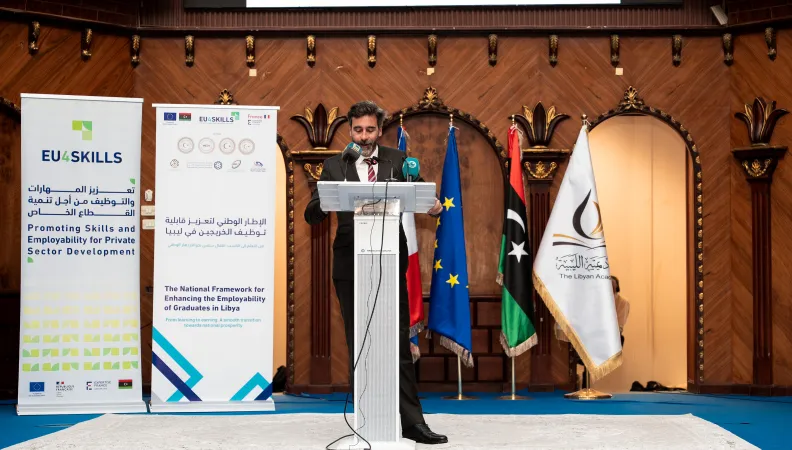
Tripoli, Libya – June 22, 2026 – The Ministry of Higher Education and Scientific Research, together with the Ministry of Technical and Vocational Education, Ministry of Labour and Rehabilitation, the European Union, and Expertise France, officially announced the completion of the National Framework for Enhancing Graduates’ Employability in Libya, establishing a unified national reference to address the persistent challenge of translating education outcomes into sustainable employment.
The Framework provides a results-based structure to guide policy reform, institutional coordination, and implementation mechanisms designed to accelerate professional integration and support Libya’s broader economic diversification and national development priorities.
The validation marks a major milestone in Libya’s efforts to address structural graduate unemployment, labour market absorption challenges, and the long-standing mismatch between education outputs and economic demand. It reflects a high-level national commitment to positioning employability as a core function of both higher education and vocational education systems.
The Framework was developed through a collaborative process led by a team from the Ministry of Higher Education and Scientific Research, the Ministry of Technical and Vocational Education and the Ministry of Labour and Rehabilitation with the support of international partners under the EU4Skills project, funded by the European Union, with a contribution from the French Government, and implemented by Expertise France. The development process brought together public institutions, education leaders, private sector representatives, and technical experts, ensuring national ownership and broad-based participation from all Libyan regions. The Framework also draws on international expertise and comparative case studies while being adapted to Libya’s institutional and economic context.
The Framework is structured around four strategic goals that apply across both higher education and vocational pathways:
- Developing competitive competencies aligned with modern labour market needs;
- Expanding and diversifying employability pathways, with a focus on stronger private sector engagement;
- Promoting entrepreneurship, self-employment, and innovation within educational institutions;
- Generating sustainable societal and economic impact through improved education outcomes.
By modernizing curricula, expanding internships, and launching career guidance services, this initiative introduces practical tools to bridge the gap between 'learning and earning.' Through data-driven tracking and regulatory reforms, Libya is building a more responsive education system that adapts to the evolving needs of the job market
The Framework’s implementation follows a strategic roadmap, starting with foundational reforms and institutional capacity-building before scaling these initiatives across all Libyan regions. Designed for long-term sustainability, the strategy links classrooms to the national economy. Ultimately, this validation represents a unified national pledge to transform academic degrees into meaningful careers, equipping Libyan graduates to excel in a global market and driving the nation's transition toward a resilient, knowledge-based economy.
Contact
Sarah Belamin, Strategic Visibility and Media Expert – Expertise France Economical program in Libya sarah.belamin@expertisefrance.fr +218946660453
About us
The European Union is made up of 27 Member States, which have decided to gradually pool their know-how, their resources, and their destiny. Together, over a period of over 50 years of enlargement, they have built an area of stability, democracy, and sustainable development, while maintaining their cultural diversity, tolerance and individual freedoms. The European Union is determined to share its achievements and values with countries and peoples beyond its borders.
Expertise France is the French public agency for international technical assistance. It aims at contributing to sustainable development based on solidarity and inclusiveness, mainly through enhancing the quality of public policies within the partner countries.
In the news
On the same topic

Project Africa-Europe Youth Academy (AEYA) - Develop youth leadership in Sub-Saharan Africa
Ongoing
2025 - 2029
Funders : European Union