Share the page

SHABAKE – Building the capacities of Lebanese civil society organisations
Project
Published on
-
Project start date
-
Status
Closed
-
Project end date
-
-
Financing amount (Euro)
-
24.5m
-
Country and region
-
Lebanon, Middle East
-
Funders
-
Agence Française de Développement, Ministry of Foreign Affairs of Denmark, Ministry for Europe and Foreign Affairs of France
The Shabake project aims to improve the resilience of Lebanese civil society, by strengthening its role in crisis prevention and management via capacity building for seven Lebanese NGOs.
International community mobilised to address the crises in Lebanon
Since the outbreak of the Syrian crisis in March 2011, more than one million people have sought refuge in Lebanon. This massive influx has had major human, social, economic and political impacts. Furthermore, the country is experiencing an unprecedented economic and financial crisis, marked by the collapse of its currency, a drop in its GDP and record inflation. The vulnerabilities have been exacerbated by security and humanitarian crises, such as the Beirut Port explosion in August 2020 and the massive airstrikes by the Israeli army on Lebanese territory, especially targeting its civil infrastructure.
These crises have highlighted the immeasurable role of civil society in supporting communities. They have also underscored the need for a collective and reinforced commitment of international aid to support local civil society.
In this respect, during the World Humanitarian Summit in Istanbul in May 2016, the international community pledged to make every effort to provide a more effective response to crises. More than 61 countries committed to this “Grand Bargain” agreement. It should lead to more financing, but especially to more support to national actors, both governmental and non-governmental, in the context of the movement for the “localisation of aid”.
Civil society organisations central to the crisis response
Shabake came about through the desire to work for the localisation of aid and the need to build the capacities of Lebanese civil society organisations (CSOs). The objective is to ensure that they play a key role in the response to the crises in Lebanon.
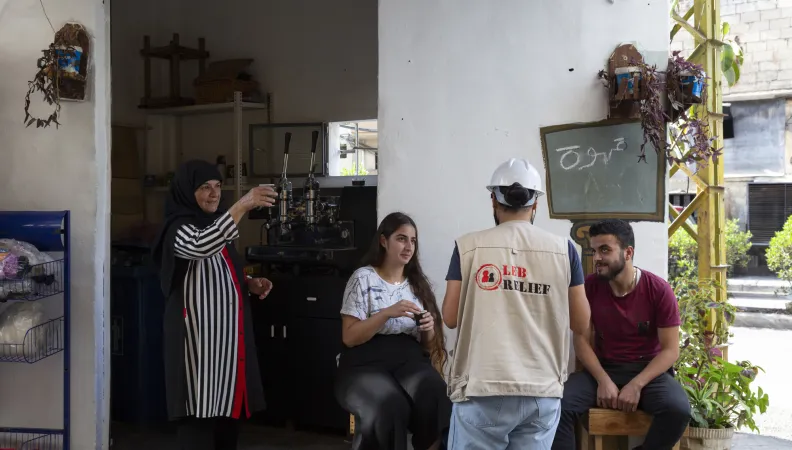
Local CSOs play an essential role in the provision of essential services to the most remote and vulnerable population groups. As they are firmly rooted in regions and communities, they can take effective action, especially in the areas most affected by the multifaceted crises. Their operations help improve access to basic services, while public facilities are saturated and municipalities are often overwhelmed.
However, most Lebanese CSOs are faced with a lack of financial resources along with technical and organisational weaknesses. This further restricts their access to international financing, which jeopardises their sustainability and independence.
First phase of the Shabake project (2019-2022)
Between 2019 and 2022, the Shabake project supported 13 Lebanese civil society organisations to enable them to take effective crisis prevention measures at local level. This first phase was based on three lines of action:
- Build the capacities of local NGOs by developing and implementing a capacity building plan to address the current needs of vulnerable population groups and prevent and manage future crises
- Ensure that each NGO implements a project to reduce vulnerability to crises
- Reinforce the integration of partner NGOs into the aid ecosystem by setting up a network between these NGOs, putting them in contact with donors, and strengthening existing coordination mechanisms between donors to support Lebanese civil society
The first phase of the Shabake project was financed by Danida (Denmark) and AFD (France).
Shabake II (2022-2025): a second phase to continue the action to support civil society
In a context of growing political and economic instability, we have adapted our approach and are continuing the activities of the Shabake project with financing from AFD and the Crisis and Support Centre of the French Ministry for Europe and Foreign Affairs.
This second phase still involves strengthening the role of Lebanese civil society in crisis prevention and resolution. The objective is to contribute to peace, security and the recovery of Lebanon. It targets 50 CSOs, some of them small, across the country.
As with the first phase, the entire project aims to be inclusive and participatory. The NGOs will be agents of change by participating in assessment and capacity building activities. The project also contributes to building networks among the partner NGOs, which are encouraged to work even more closely with the Lebanese authorities and local public institutions.
Building the capacities of Lebanese civil society
Capacity building activities for civil society are organised in various sectors, ranging from occupational integration to agriculture, and including waste treatment, education, health and access to basic services.
A first cycle, comprising 13 projects to reduce vulnerabilities, was launched in April 2023 and was successfully completed in 2024. At that time, vocational training was organised and initiatives were undertaken to support entrepreneurship, education and agriculture.
The second cycle, comprising 12 projects, is currently being implemented and is in the closing phase. These projects target:
- Waste management
- The strengthening of services for mental health and maternal and child health
- The rehabilitation of water and sanitation infrastructure
- Entrepreneurship
- Local governance
To date, more than 15,000 people have benefited from these operations in Lebanon.
Improving crisis response capabilities
The second line of action aims to create an emergency reserve composed of CSOs that develop proposals for interventions, submitted on a monthly basis, which will benefit from rapid financing. The objective is to adapt as far as possible to developments in the situation in Lebanon and address the emergence of urgent needs following short-term and protracted crises. In this respect, 37 projects will be financed.
To date, 32 crisis response activities have already been implemented, supporting more than 25,000 beneficiaries, with a focus on people who have been internally displaced by the Israeli airstrikes on the country. These operations include:
- The distribution of essential goods
- Opening emergency shelters
- Psychosocial support sessions
The education sector also has pressing needs, as schools were closed and converted into emergency shelters during the war. Five local CSOs have been selected to support the sector. The objective is to rehabilitate infrastructure, increase access to education, organise individualised follow-up and support teaching staff.
Follow the Shabake project on the social networks:
For further reading
Similar projects
Promoting the resumption of essential service provision for conflict-affected communities in Ethiopia
Ongoing
2023 - 2027
Funders : Ministry for Europe and Foreign Affairs of France, European Union
HERNES - Health Recovery in North-East Syria
Ongoing
2019 - 2026
Funders : Ministry for Europe and Foreign Affairs of France, European Union
Pilot Project for the Redeployment of Decentralized Services, Enhancement of Social Cohesion and Early Recover...
Closed
2016 - 2019
Funders : European Union