
Share the page
Conference - Technology-facilitated gender-based violence (TFGBV): cooperating for a safer digital world

-
When
-
-
Schedule
-
14h - 16h
On the occasion of International Women's Rights Day, Expertise France has organised a conference on 17 March 2026 at the Cité Audacieuse — an iconic Parisian third place dedicated to the defence of women's rights — devoted to the fight against TFGBV, existing best practices and innovative digital solutions promoted by actors of change.
Digital technology: threat or lever for women's rights?
98% of deepfake videos posted on the internet depict non-consensual pornographic images, 99% of which target or feature women (2023: State of Deepfakes, Security Hero). While the rise of digital technology and the democratisation of artificial intelligence (AI) have fuelled hopes for a more connected world and greater autonomy for the most marginalised populations, these technologies have also amplified and facilitated online violence against women, girls and gender minorities. Mass harassment, disclosure of personal data (doxing), non-consensual distribution of intimate images (revenge porn), death or rape threats, online stalking, disinformation, identity theft and online grooming now constitute a continuum of digital violence against women with very real consequences.
The feeling of anonymity offered by certain digital spaces, the proliferation of masculinist forums and the manosphere, the lack of judicial response to cyber violences, the inadequacy of binding legal frameworks and the still limited responsibility of platforms, as well as the backlash of women's and girls' rights by anti-rights governments, have contributed to making the internet and social media particularly hostile environments for women, girls and gender minorities. This violence has lasting and dissuasive psychological effects: according to a Plan International study conducted in 22 countries, 58% of young women aged 15 to 25 report having experienced abuse or harassment online, and nearly 19% have left or restricted their presence on social media as a result of an attack. In Latin America and the Caribbean, 80% of women in public office limit their online activities for fear of abuse (UN Women). In a context of drastic budget cuts worldwide, which are forcing many feminist and human rights organisations to reduce or halt their activities, national and international cooperation appears more essential than ever to support civil society and respond to digital threats that are transnational in nature.
Since 2022, the United Nations has adopted the term ‘technology-facilitated gender-based violence’ (TFGBV), following a global consultation with experts, in order to better describe and raise awareness of these contemporary forms of violence. The emerging definition of the phenomenon is qualified by UN Women as: “any act that is committed, assisted, aggravated, or amplified by the use of information communication technologies or other digital tools that results in or is likely to result in physical, sexual, psychological, social, political, or economic harm, or other infringements of rights and freedoms.” France's International Strategy for Feminist Diplomacy (2025-2030) identifies TFGBV as one of the major global issues requiring a stronger political, diplomatic and operational response. The French legislative framework for combating online hate speech and content has also been strengthened in recent years: the recent SREN Act of 2024, for example, which aims to adapt French law to implement the European ‘Digital Services Act’ (DSA), the implementation of which is coordinated by Arcom, thus enables sanctions and obligations to be imposed on online platforms to combat the dissemination of illegal content.
Nonetheless, digital technology can also be a powerful tool in the fight against TFGBV. Technologies for detecting and removing abusive content (Disrupt for example), reporting tools and recommendations of good practices, secure platforms to support and protect survivors, digital awareness-raising campaigns, the collection of data on various forms of online violence, strengthening the digital capabilities of feminist organisations, and online advocacy for more protective legal frameworks: responsible and feminist uses of digital technology offer concrete solutions to prevent violence, protect victims and transform power relations in digital spaces.
A hybrid conference at the Cité Audacieuse to share best practices and digital innovations
Organised in partnership with the Fondation des Femmes at the Cité Audacieuse, a cultural hub and home to feminist associations, and moderated by Mathilde Saliou (journalist and author), this hybrid conference has brought together French and international institutional partners, as well as actors from the associative, private, public and research sectors. The conference was translated live into French, English and Spanish.
An initial round-table discussion brought together four experts to discuss the theme ‘Global threats, transnational responses’. “Our studies have shown that cyberbullying is clearly gendered: whilst male politicians or athletes are attacked for their actions and words, women are automatically targeted for their physical appearance,” explained Laurence Pécaut-Rivolier, member of the board of the French Regulatory Authority for Audiovisual and Digital Communication (Arcom). Her presentation, along with that of Eva Villarreal Pascual, Gender Specialist at the Inter-American Commission of Women, highlighted the challenges posed by the very nature of the digital space, which transcends national legal frameworks and calls for regulatory mechanisms at European and international level.
On the civil society side, Iman Karzabi, head of the Regional Observatory on Violence against Women at the Centre Hubertine Auclert, emphasised the need to establish clear and accessible support mechanisms to meet victims’ needs: “It is essential that victims have a single point of contact,” she stated. Ousseynou Gueye, founder and executive director of Polaris Asso in Senegal, highlighted the importance of participatory approaches, noting that “every citizen must be able to play an active role in prevention”.
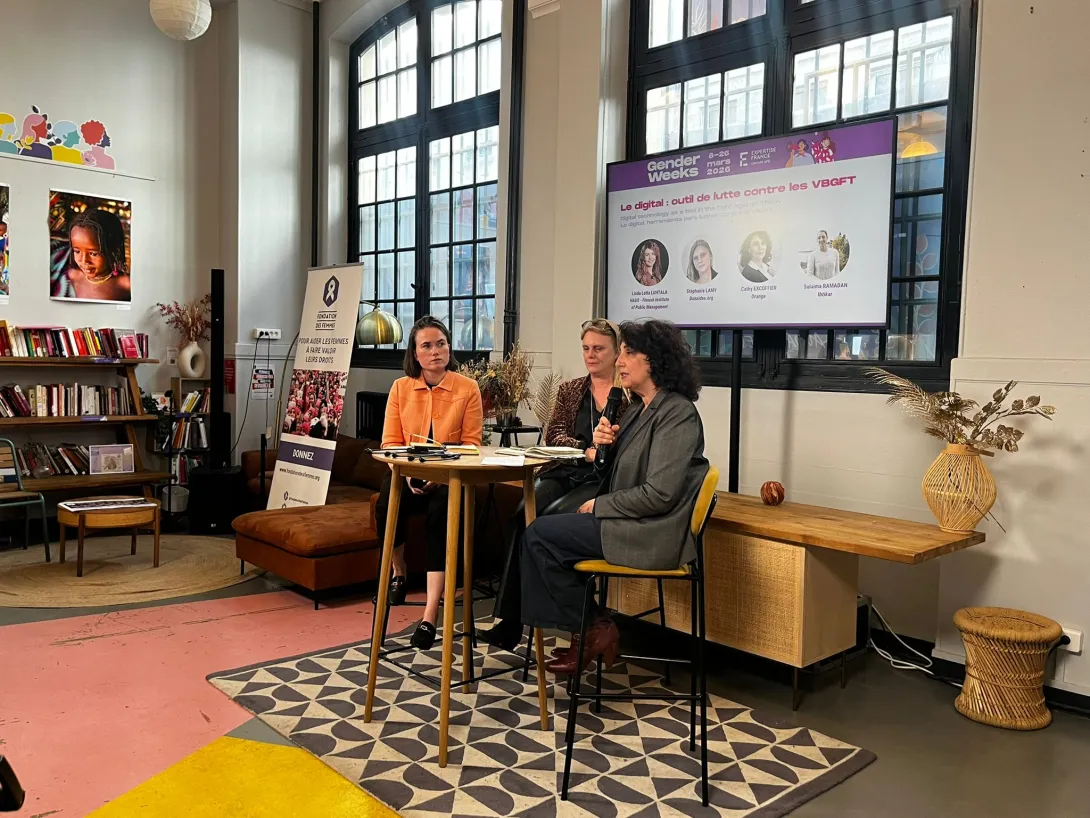
In the second panel discussion, Linda Lotta Luhtala, project manager at HAUS – Finnish Institute of Public Management, pointed out that legal frameworks, whilst necessary, remain inadequate without effective accountability mechanisms and without greater consideration of victims’ lived experiences. Stephanie Lamy, activist and co-founder of Danaïdes.org, called for innovation “from the margins”, which takes into account the realities of the most vulnerable populations in order to rebuild digital ecosystems in an inclusive manner. Cathy Excoffier, Deputy Director of CSR at Orange, emphasised the challenges of raising awareness, particularly among young people, and of including women and girls in digital transformations, particularly those linked to artificial intelligence, highlighting the collective responsibility of public and private actors in this area.
on the same topic
#RDVExpertise Gender-based Violence
What is the real state of sexual and gender-based violence in the world today? How can legal institutions, public policies and international cooperation frameworks respond effectively? And how is the ...
Online
#RDVExpertise Global Health and Gender
Watch the replay of our latest #RDVExpertise event from 4 December 2025 and follow the fascinating debates on the challenges of integrating gender into global health policies!
Online