Share the page
« Online gender-based violence is an increasingly serious issue in Palestine »
Published on
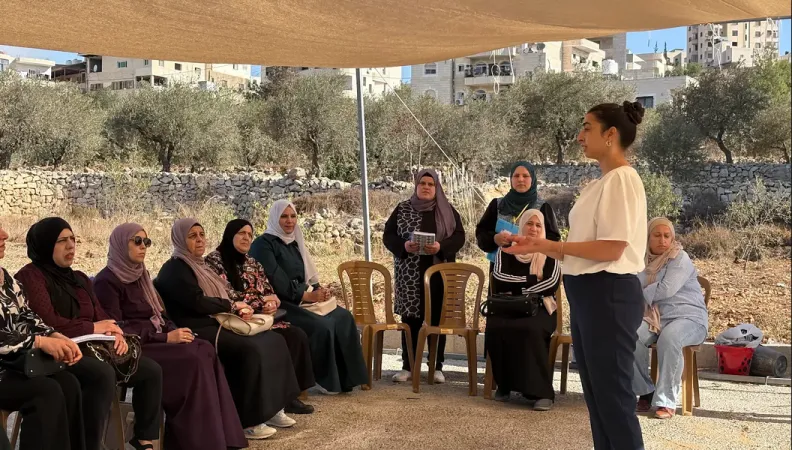
Technology-facilitated gender-based violence amplifies abuse both online and offline. In response, Expertise France supports an 11-month project led by the NGO Ibtikar in Bethlehem and Hebron to strengthen digital literacy and online safety. So far, 40 workshops have trained nearly 200 participants—mostly women—providing protection tools, legal support, and an AI app to report abuse.
Technology facilitated gender-based violence (TFGBV) has alarming consequences in the physical world, digital tools often serving amplifiers of sexual violence and exploitation. As part of the Laboratory for Women’s Rights Online initiative, initiated by France’s Ministry for Europe and Foreign Affairs, Expertise France supports the NGO Ibtikar in combatting these phenomena through awareness-raising, education and digital innovation in Bethlehem and Hebron. Over the course of 11 months, the project will enhance digital literacy and create safer online practices. To date, it has already organized 40 workshops attended by nearly 200 participants (80% of women), equipping them with the tools to navigate and protect themselves in digital spaces. The initiative also intergrates knowledge exchange, legal assistance and the development of an AI-powered app designed to detect and report online abuse.
Sulaima Ramadan, Palestinian social entrepreneur and CEO of Ibtikar for Empowerment and Social Entrepreneurship works alongside these women to enhance their digital resilience amid an environement shaped by social and political instability.
As the CEO and founder of Ibtikar, could you share the story behind the organisation and the philosophy that guides its work in building resilience within communities?
Sulaima Ramadan : Ibtikar for Empowerment and Social Entrepreneurship was founded in Bethlehem with a very simple observation: in many Palestinian communities, especially in less-served areas, women and young people possess immense creativity, skills, and determination, yet they often lack the opportunities, networks, and support systems needed to transform their ideas into sustainable livelihoods and create opportunities within their communities.
At the same time, many small social initiatives and community projects in Palestine struggle to find structures that truly understand and support social entrepreneurship — initiatives that combine social impact with economic sustainability. This gap highlighted the need for a space that could nurture ideas, accompany emerging initiatives, and help communities translate their creativity and resilience into tangible opportunities. Ibtikar was created as a response to this need.
Today, Ibtikar works primarily in the southern West Bank, particularly in Bethlehem, Hebron, and surrounding communities. Our mission is to support women, youth, small entrepreneurs, refugees, and other marginalized groups through training, mentorship, and practical opportunities that connect skills with real socio-economic pathways.
Over the years, we have built a growing community of hundreds of women and young people who are developing micro-enterprises, handicraft initiatives, cultural products, and social projects despite very difficult political and economic conditions. For us, resilience is not an abstract concept. It is the daily ability of people to continue creating, working, and supporting one another even in highly constrained environments.
At Ibtikar, we do not see beneficiaries simply as recipients of support. We aim to create a community where participants grow together, share experiences, and support one another. In that sense, Ibtikar is not only an organisation but also a space of collective learning, solidarity, and creativity.
Global surveys suggest that nearly four in ten women have personally experienced some form of online violence. In the Palestinian context, how does this issue manifest, and how do political and social realities shape women’s experiences online?
Sulaima Ramadan : Online gender-based violence is an increasingly serious issue in Palestine, particularly for young women and women who are visible in public life, entrepreneurship, media, or activism.
Women who express opinions online, run businesses on social media, or participate in public discussions often face harassment, intimidation, threats, and attempts to shame or silence them. In some cases, this includes the misuse of personal photos, blackmail, coordinated harassment campaigns, or the spreading of defamatory content.
In the Palestinian context, these challenges unfold within a broader political and social reality shaped by prolonged military occupation, restrictions on movement, and recurring instability. Because mobility and economic opportunities are heavily constrained, digital spaces have become essential arenas for Palestinians to communicate, advocate, and access markets.
At the same time, Palestinian civil society organizations have repeatedly raised concerns about the restriction or removal of Palestinian content on social media platforms. In some cases, online expression can also carry serious personal risks, as Palestinians have faced legal consequences or arrest linked to their digital activity or political expression online. This creates an environment where many people—particularly women who already face social pressures—may feel additional fear or hesitation when speaking publicly in digital spaces.
Digital platforms therefore represent both opportunity and risk. They allow Palestinian women—especially small entrepreneurs—to access economic opportunities and reach customers through social media, while also exposing them to harassment, intimidation, and forms of online violence that remain insufficiently addressed.
Many women who experience online harassment choose not to report it due to fear of social consequences, lack of awareness of reporting mechanisms, or a general perception that little can be done. This silence can reinforce cycles of intimidation and exclusion from digital and economic participation. In such an environment, ensuring that women can safely participate in digital spaces is not only a matter of online safety, but also of protecting their voice, agency, and presence in public life.
Within the Laboratory for Women’s Rights and its focus on technology-facilitated gender-based violence, what role is Ibtikar playing in Palestine?
Sulaima Ramadan : Within the framework of the Laboratory for Women’s Rights Online supported by Expertise France, Ibtikar contributes to strengthening digital resilience among women and girls in Palestine, particularly in the southern West Bank.
Our work focuses on equipping women with the knowledge, tools, and confidence needed to navigate digital spaces safely. We conduct digital literacy and digital safety training sessions that help participants better understand online risks, protect their personal data, manage privacy settings, and recognize different forms of online harassment and manipulation.
Another important aspect of our work is raising awareness about legal rights and available reporting mechanisms. Many women are not aware that certain forms of online abuse can be reported. Through our activities, we introduce participants to relevant local structures, including the Palestinian Authority’s Cybercrime Combating Unit, so they can better understand the options available to them.
In parallel, we create safe spaces for dialogue where women can openly discuss their experiences with online harassment, share strategies for protection, and break the silence that often surrounds technology-facilitated gender-based violence.
Finally, part of our work also involves developing and exploring technological tools and digital platforms that can support reporting, documentation, and awareness-raising around online violence.
Through this work, we aim to ensure that Palestinian women are not pushed out of digital spaces by intimidation or violence, but rather equipped with the knowledge, tools, and community support needed to navigate them safely.
In the news
EnMAR Voices: A Podcast to Give Women a Voice in Maritime and Port Security
Published on March 10, 2026
Fighting Online Scams: How the EU ESIWA+ Project Strengthens Cyber Cooperation with the Indo-Pacific
Published on February 12, 2026
on the same topic
Women Leadership in public ICT sector (WLICT)
Ongoing
2025 - 2028
Funders : European Union, Agence Française de Développement, Ministry for Europe and Foreign Affairs of France, German Federal Ministry for Economic Cooperation and Development (BMZ), Belgian State, Estonian Ministry of Foreign Affairs, Latvia Central Finance and Contracting Agency
African-European Museum Partnerships
Ongoing
2025 - 2030
Funders : European Union, Agence Française de Développement, German State, Belgian State, Government of The Netherlands
EnMAR+ – Enhanced Maritime Action in the Gulf of Guinea, Red Sea and Western Indian Ocean
Ongoing
2026 - 2028
Funders : European Union